
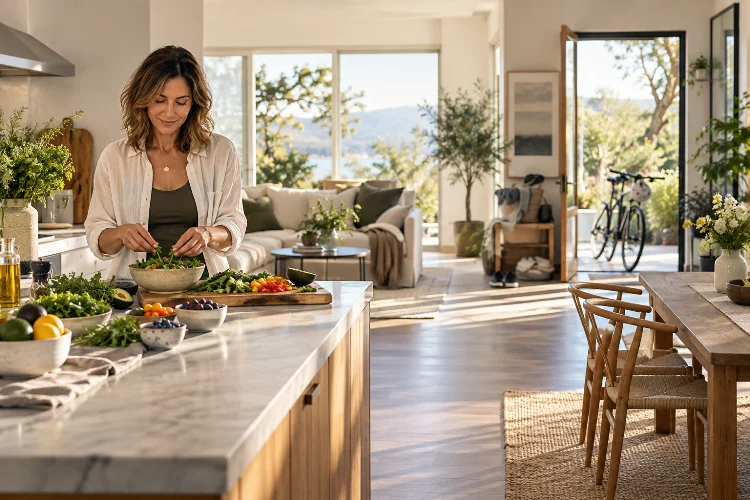
Most people think about health in terms of individual choices: eat better, exercise more, sleep enough, and avoid bad habits. All of that matters, but there is another layer that often gets overlooked – the way your everyday life is actually designed.
Your schedule, home environment, work habits, social circle, food choices, commuting patterns, and even where you place your phone at night can influence what you repeatedly do.
Over months and years, those small patterns can shape your physical health, mental well-being, and risk of chronic disease.
That is the basic idea behind lifestyle design. Instead of depending entirely on motivation, you intentionally structure your routines and surroundings so healthier behaviors become easier to maintain.
This matters for longevity because health is rarely determined by one perfect week.
Research and public-health guidance consistently point toward long-term patterns involving movement, nutritious food, sleep, tobacco avoidance, social connection, and cardiovascular health.
The goal is not to create a flawless life. It is to build one where healthy choices happen more naturally.
1. Design Your Environment Before Relying on Willpower
Willpower can help you start a healthy habit, but your environment often decides whether that habit survives.
Imagine two people who both want to walk more. One keeps walking shoes beside the front door and has a safe route near home. The other has to find equipment, drive somewhere, and reorganize a busy schedule every time.
The first person has reduced friction.
This is lifestyle design in practice. You make desired behaviors convenient and unwanted ones slightly harder.
Fruit can be kept visible on the kitchen counter, while highly processed snacks stay out of immediate reach. Exercise clothes can be prepared the night before, and a phone charger can be placed outside the bedroom.
These tiny environmental changes sound almost too simple, but simplicity is exactly what makes routines more consistant.
A healthy lifestyle should not require dozens of difficult decisions every day. Good design reduces the number of decisions you need to make.
2. Build Movement Into Daily Life
Exercise is important, but movement should not exist only inside a scheduled workout.
The World Health Organization reports that insufficiently active people have about a 20% to 30% higher risk of death compared with people who are sufficiently active.
Regular physical activity is also associated with lower risks of cardiovascular disease, type 2 diabetes, certain cancers, and other health problems.
That makes movement a powerful part of long-term health planning.
Make Activity the Default Option
You might walk for short errands, take stairs when practical, schedule walking meetings, stretch between work sessions, garden, cycle, or take a short evening walk after dinner.
Structured exercise still matters. The American Heart Association recommends around 150 minutes of moderate physical activity or 75 minutes of vigorous activity each week as part of its cardiovascular health guidance.
The bigger idea, however, is to stop treating movement as something separate from normal life.
Someone who walks regularly, performs strength training twice a week, and takes frequent movement breaks may find physical activity easier to sustain than someone relying on occasional intense workouts.
3. Create an Eating System, Not a Temporary Diet
Short-term diets often depend on restriction. Long-term nutrition works better when healthy food becomes part of a repeatable system.
That may mean planning several reliable breakfasts, preparing ingredients before the workweek, keeping nutritious snacks available, and having simple meals you can cook when you are tired.
Current dietary guidance emphasizes whole, nutrient-dense foods such as vegetables, fruits, protein foods, healthy fats, dairy where appropriate, and whole grains while reducing highly processed foods.
The National Institute on Aging similarly recommends varied, nutrient-rich eating patterns and adequate protein, particularly as people get older and maintaining muscle becomes increasingly important.
The point is not to achieve perfect nutriton at every meal.
If roughly 80% of your normal food environment supports healthier choices, occasional desserts, restaurant meals, or celebrations become much easier to enjoy without feeling that your entire routine has failed.
4. Protect Sleep With Better Daily Structure
Sleep is sometimes treated as leftover tim – something that happens after work, entertainment, chores, and social media are finished.
That design rarely works well.
The CDC notes that sleep is important for physical health and emotional well-being. Recommended sleep varies by age, with most adults needing at least seven hours per night.
In 2024, 30.5% of U.S. adults reported averaging fewer than seven hours of sleep in a 24-hour period, according to CDC data.
Lifestyle design makes sleep a scheduled part of the day rather than an accident.
A practical evening routine could include dimming lights, stopping demanding work at a defined time, charging devices away from the bed, and maintaining a fairly stable wake-up time.
Your daytime enviroment matters too. Exposure to natural light, regular activity, and limiting late caffeine can all support better sleep habits.
5. Reduce Chronic Stress by Designing More Recovery
Modern life often rewards constant availability.
Messages arrive throughout the day, work follows people home, and free time can easily become another opportunity to consume information. Over time, that can make genuine recovery surprisingly rare.
A healthier lifestyle includes deliberate periods when your nervous system is not constantly responding to demands.
That could mean walking without your phone, taking short breathing breaks, spending time outdoors, meditating, praying, journaling, gardening, or simply leaving empty space in the calendar.
The goal is not to eliminate stress. Some stress is unavoidable and can even be useful.
Instead, design enough recovery into everyday life that stress does not become the permanent background setting.
Think of recovery like charging a battery. Waiting until you are completely exhausted is usually less effective than recharging regularly.
6. Make Social Connection Part of Your Health Plan
Health is not only built in kitchens, bedrooms, and gyms.
Relationships matter too.
The CDC states that strong social connections are associated with better mental and physical health and can support longer, healthier lives. Social isolation and loneliness, by contrast, are associated with increased risks of several health problems.
This does not mean you need a huge social circle.
Regular interaction with a few meaningful people may be far more valuable than hundreds of superficial connections. Lifestyle design can help by creating recurring opportunities for contact.
You might schedule a weekly meal with family, join a sports group, volunteer monthly, attend a community activity, or call a friend during your Sunday walk.
When relationships are built into routines, connection is less likely to disappear during busy periods.
7. Focus on Healthspan, Not Just Lifespan
Living longer is one goal. Living longer while remaining active, independent, and mentally engaged is another.
This is where the idea of healthspan becomes useful.
Healthspan refers broadly to the years of life spent in relatively good health.
Lifestyle factors that protect cardiovascular health, maintain physical activity, support sleep, and reduce disease risk may contribute not only to longer life but also to more years of better functioning.
Research highlighted by Harvard found that people who followed several healthy habits in middle age tended to experience more years of life free from major chronic diseases such as cardiovascular disease, cancer, and type 2 diabetes.
That makes the question more practical.
Instead of asking, “How can I live to 100?” ask, “What kind of daily life could help me remain capable at 60, 70, 80, and beyond?”
That shift encourages sustianable habits rather than extreme longevity experiments.
Lifestyle design influences long-term health because your routines shape what you repeatedly eat, how much you move, how well you sleep, how often you recover, and whether meaningful relationships remain part of your life.
You do not need to redesign everything overnight. Start with one area that creates unnecessary friction.
Prepare healthier food in advance, schedule regular walks, establish a bedtime routine, protect some recovery time, or make social connection a recurring commitment.
Then build from there.
Longevity is rarely created by one dramatic decision. It is more often the result of ordinary behaviors repeated for years.
Design your environment and schedule so the healthier option becomes the easier option, and your future self may benefit from thousands of small choices made almost automatically.