
Most people approach habit change by asking one question: “How can I become more disciplined?” It sounds reasonable, but it puts almost all the responsibility on motivation and self-control.
There is another approach. Change the environment around the behavior.
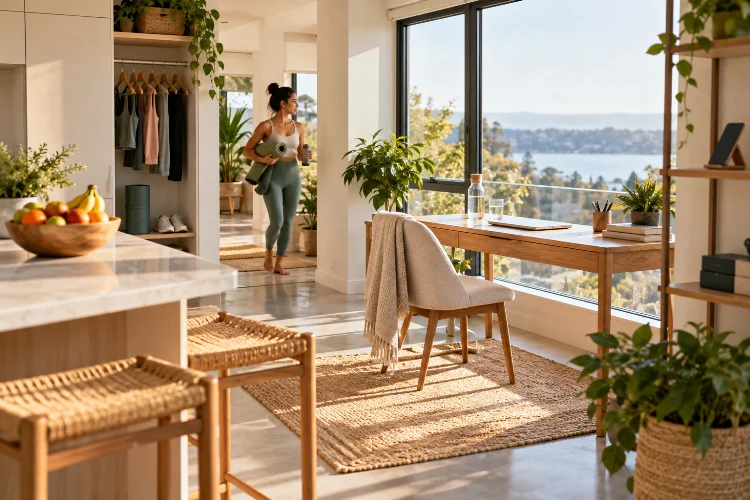
Where your phone sits, what food you see first, how easy your workout clothes are to reach, and even where your desk faces can quietly influence what you do next.
Habit research shows that repeated actions in recurring contexts can become increasingly automatic, meaning environmental cues can play an important role in maintaining behavior over time.
Understanding how environment design makes positive habits easier to maintain is therefore less about creating a perfectly organized home and more about reducing unnecessary decisions.
A well-designed environment makes good actions visible, convenient, and obvious. At the same time, it can add enough friction to less useful behaviors that you have a moment to reconsider them.
The result is not perfect behavior. It is a daily system that requires less effort to maintain.
1. Make the Desired Habit Easy to Notice
Habits often begin with cues.
You walk into the kitchen and see cookies on the counter. You automatically pick one up. You notice your phone beside your laptop and check a notification before starting work.
The environment is constantly presenting behavioral invitations.
Research on habits describes how repeated responses in stable contexts can eventually be triggered more automatically by those contexts.
You can use the same mechanism intentionally.
If you want to drink more water, place a filled bottle on your desk instead of leaving it inside a cupboard. If you want to read before bed, leave the book on your pillow or bedside table.
Want to exercise in the morning? Put your clothes and shoes somewhere impossible to miss.
Visibility Creates Behavioral Reminders
The goal is not to cover your house with sticky notes.
Instead, give important habits a clear physical presence.
Healthy food should be easy to see. Exercise equipment should be accessible. Work materials should already be where focused work occurs.
When good choices are hidden, they require memory. When they are visible, the enviroment does part of the remembering for you.
2. Reduce Friction Around Positive Behaviors
Every action has a small cost.
Sometimes that cost is physical. Sometimes it is time, inconvenience, mental effort, or the number of steps required to begin.
Imagine that exercising requires finding your shoes, locating workout clothes, moving furniture, searching for equipment, and deciding which routine to follow.
None of those tasks is particularly difficult.
Together, however, they create friction.
Reduce that friction before motivation becomes necessary.
Prepare your equipment in advance. Save your workout program. Keep healthy ingredients ready to use. Create a permanent study area instead of rebuilding one every evening.
Research on environmental and choice architecture interventions supports the broader idea that changing availability, positioning, convenience, and surrounding conditions can influence behavior.
The easier the first step becomes, the less psychological energy you need to start.
3. Add Friction to Habits You Want Less Often
Environment design works in both directions.
If making positive habits easier helps, making unwanted behaviors slightly harder can also be useful.
Suppose you regularly lose 30 minutes scrolling on your phone after waking up.
Instead of relying on morning self-control, charge the phone across the room – or outside the bedroom. Turn off nonessential notifications. Remove the most distracting apps from your home screen.
You have not made phone use impossible. You have simply added a few seconds of friction.
Those seconds create a decision point.
The same principle can work with food, spending, entertainment, and digital distractions.
Keep less nutritious snacks somewhere less visible. Remove stored payment information from shopping websites if impulsive purchases are a problem. Log out of platforms you tend to open automatically.
Small obstacles can interrupt automatic behavior long enough for conscious choice to return.
4. Design Healthy Defaults
A default is what happens when you do nothing differently.
Defaults can have surprisingly strong effects on decisions. A meta-analysis covering 58 studies and more than 73,000 participants found substantial overall effects from default options, although results varied considerably across settings.
You can create personal defaults too.
Your default breakfast might become yogurt, oats, and fruit rather than deciding from scratch every morning.
Your default response to a short commute could be walking when practical.
Your default work setup could start in focus mode with distracting notifications disabled.
This eliminates repeated negotiation.
The idea is not to remove freedom. You can always choose something different.
A useful default simply ensures that when you are tired, rushed, or distracted, the easiest available option is still reasonably aligned with your goals.
5. Organize Food Environments Around Better Choices
Food habits are especially sensitive to availability, placement, and convenience.
Reviews of choice architecture interventions suggest that strategies involving food availability, positioning, salience, and related environmental features can influence purchasing and eating choices, although effectiveness differs across contexts.
At home, this does not require redesigning the kitchen.
Put fruit somewhere visible. Store vegetables where they are easy to access. Prepare healthy snacks before you become hungry.
Place water where you spend most of your day.
Meanwhile, foods you want to eat less frequently do not necessarily need to be banned. Simply avoid giving them the most convenient and visible location.
The principle is simple: organize the kitchen around the behavior you want most often, not around whatever fits randomly into each cabinet.
Better nutriton becomes easier when the environment supports it.
6. Give Important Habits a Dedicated Place
Physical spaces can become behavioral cues.
If you work, eat, watch entertainment, and scroll social media from exactly the same chair, the environment provides few clues about which mode you should be in.
Creating dedicated zones can help.
Your workspace does not need to be an entire office. It could be one desk or even one end of a table that is consistently used for focused tasks.
A particular chair can become your reading spot. One clear section of the floor can be your workout area.
Research on built environments indicates that physical characteristics of homes, workplaces, and other spaces can influence motivation, health-related behavior, stress, and perceptions of well-being, although effects depend on context and design.
Workplace research similarly finds that features such as workstation design, stairs, amenities, and surrounding environments can affect movement and sedentary behavior.
Space quietly communicates what behavior belongs there.
Use that communication deliberately.
7. Design Your Digital Environment Too
Your environment is no longer only physical.
Your phone, computer, inbox, browser, streaming apps, and notification settings create another behavioral landscape that you move through all day.
A cluttered digital environment can make distracting habits extremely convenient.
If social media is one tap away while your learning app is hidden inside a folder, you have already designed a behavioral preference – even if you did not mean to.
Reverse it.
Put useful tools on the home screen. Remove unnecessary notifications. Use website blockers during focused work. Keep entertainment apps off work devices when practical.
You can also simplify your desktop and browser so the first thing you see supports the task you intended to complete.
A funcional digital environment reduces the number of temptations competing with your goals.
You should not have to win a battle with twenty notifications every time you want to concentrate.
8. Pair Environment Design With If-Then Planning
Environmental design works even better when you already know what a cue means.
This is where implementation intentions can help.
An implementation intention takes the form: “If situation X happens, then I will do Y.”
A major meta-analysis of 94 independent tests found that these specific if–then plans improved goal attainment and helped people translate intentions into action.
For example:
“If I place my coffee on the desk in the morning, I will write for ten minutes before opening email.”
Then design the environment to support that sequence. Keep your notebook open beside the coffee spot and your email application closed.
The physical cue and behavioral plan now reinforce each other.
That is far more reliable than simply saying, “I really need to write more.”
9. Make Your Environment Easy to Reset
Even good systems gradually become messy.
Workout equipment gets moved. Papers accumulate on the desk. Healthy food disappears from the refrigerator. Charging cables migrate into random rooms.
That is normal.
Instead of expecting your environment to stay perfect, create a simple reset routine.
Spend ten minutes in the evening returning objects to the places that support tomorrow’s habits. Refill your water bottle, prepare workout clothing, clear your desk, and put useful items back where they are visible.
Think of this as behavioral maintainance.
A well-designed environment is not one that never becomes disorganized. It is one that can be restored quickly.
This also prevents one chaotic day from turning into several weeks of abandoned routines.
Positive habits become easier to maintain when your surroundings stop working against them.
Visibility can create cues, lower friction can make useful actions easier to start, and thoughtful defaults can reduce the number of decisions you make every day.
The opposite works too. Adding small obstacles can interrupt distractions and unwanted routines before they become automatic.
Start with one habit today.
Look at the environment surrounding it and ask three questions: Is the cue obvious? Is the behavior easy to begin? Is something else easier and more distracting?
Then change one element.
Sustainable habits do not always require stronger discipline. Sometimes the smartest solution is simply designing a world around you where the better choice becomes the easier choice.