Fashion trends move fast. One season everyone wants oversized tailoring, the next it is ultra-slim silhouettes, a specific sneaker, a particular shade of brown, or an aesthetic that suddenly appears everywhere on social media.
Following trends can be fun. The problem starts when your wardrobe becomes a collection of temporary personalities.
Developing personal style beyond seasonal fashion trends means learning which colors, shapes, fabrics, proportions, and details consistently feel right for you.
Research into personal clothing style suggests that style can be connected with self-concept, including expressions of the true, ideal, and creative self. In one qualitative study, self-knowledge, consistency, and comfort emerged as important parts of personal clothing style.
This does not mean ignoring fashion or wearing the same clothes forever. Trends can still provide inspiration.
The difference is that your wardrobe has a stable identity underneath them. Instead of rebuilding your look every season, you selectively introduce ideas that already make sense with who you are.
1. Study Your Real Wardrobe Before Searching for Inspiration
The fastest way to understand your style may be to stop looking at other people’s outfits for a moment.
Look at what you actually wear.
Which jeans leave the wardrobe every week? Which jacket makes almost every outfit better? What do you reach for when you have ten minutes to get dressed?
Wardrobe research highlights the value of looking at clothing as a connected system rather than studying garments only as individual objects.
Try photographing your outfits for two or three weeks. Do not photograph what you wish you wore. Record normal workdays, weekends, dinners, errands, and casual mornings.
Patterns will appear.
Maybe you constantly choose relaxed trousers and fitted tops. Perhaps you prefer monochrome outfits, structured jackets, soft knitwear, or minimal sneakers.
Those repetitions are not boring. They are clues to your real style.
2. Develop Two or Three Signature Silhouettes
Trends often focus heavily on individual items, but personal style becomes much clearer when you understand proportions.
Think in silhouettes.
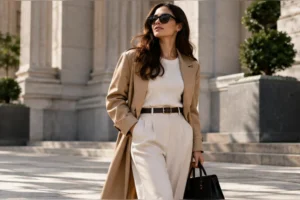
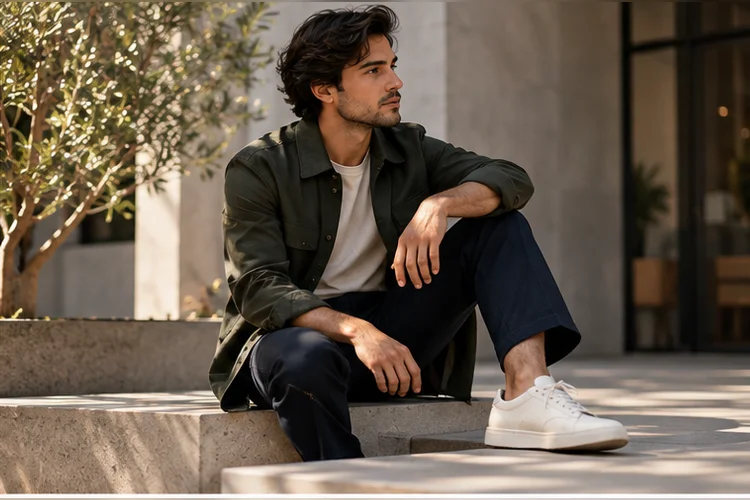
Maybe your favorite combination is wide trousers, a compact top, and a cropped jacket. Another formula could be straight jeans, an oversized shirt, and simple leather shoes.
Choose two or three shapes that consistently feel comfortable and flattering to you.
Once you understand your preferred silhoutte, seasonal fashion becomes easier to filter.
Suppose dramatic oversized blazers become popular. You do not need to reject the trend completely. You can choose a slightly relaxed blazer that still works with your usual proportions.
This approach gives you flexibility without losing visual continuity.
The garment may change, but the overall shape still feels recognizably yours.
3. Build a Color Palette That Makes Dressing Easier
A useful personal color palette is less about rigid rules and more about compatibility.
Start with several foundation colors you genuinely enjoy wearing. Black, navy, cream, olive, brown, charcoal, white, denim blue, and beige are common options, but there is no requirement to choose neutrals.
Then identify a few accent colors.
Maybe burgundy appears frequently in your wardrobe. Perhaps you naturally prefer cobalt, forest green, orange, or soft pink.
Research indicates that clothing color can influence visual perception, while factors such as skin tone and context can modify those effects. That does not create one scientifically “correct” palette for everyone.
The practical question is simpler: can your colors work together?
A consistant palette allows more garments to combine naturally, which means fewer pieces can produce more usable outfits.
4. Repeat Outfits Without Treating Repetition as Failure
One of the strangest ideas encouraged by trend-driven fashion culture is that wearing the same combination repeatedly is somehow unimaginative.
For personal style, repetition is essential.
If someone consistently wears straight trousers, crisp shirts, loafers, and simple jewelry, those elements eventually become recognizable.
Personal clothing style research similarly emphasizes consistency as part of an enduring sense of style.
Repeat what works.
You can still create variety by adjusting fabric, layering, accessories, or color.
For example, the same trousers might be worn with a T-shirt and sneakers on Saturday, knitwear and boots during cooler weather, or a shirt and blazer for work.
You are repeating the underlying formula, not necessarily the exact outfit.
That is how a wardrobe starts developing visual identity.
5. Separate Inspiration From Trend Pressure
Social media can make every trend feel urgent.
Suddenly everyone seems to own the same jacket, bag, sunglasses, or shoes. After enough exposure, an item can begin feeling essential even when it has little connection with your existing wardrobe.
Create some seperation between inspiration and purchasing.
Save an outfit first.
Wait several days or weeks before buying anything. Then ask whether you still like the item once the excitement has faded.
More importantly, imagine three outfits using clothes you already own.
If the new item requires another jacket, different shoes, and an entirely new color palette before it works, you may not be buying one garment. You may be accidentally buying the beginning of another wardrobe.
Trends are most useful when they refresh your existing style instead of replacing it.
6. Buy for Compatibility, Quality, and Actual Wear
Personal style becomes easier when you evaluate new clothing as part of your wardrobe rather than as isolated purchases.
Ask practical questions.
Does the garment fit your normal lifestyle? Can it work with multiple pieces you already own? Would you still want it if nobody on social media were wearing it?
Research into clothing use shows that garment longevity depends not only on the garment itself but also on how people use and integrate clothing into their lives.
Another 2024 study found relationships between factors including style orientation, frugality, trend sensitivity, and sustainable clothing-use practices.
This does not mean buying only expensive basics.
A colorful printed shirt that you wear fifty times can be more useful than an expensive minimalist jacket you rarely touch.
Value comes from actual use.
7. Use Accessories to Create Recognition
You do not need dramatic clothing to develop a recognizable look.
Sometimes smaller details do more work.
Perhaps you consistently wear silver rings, rectangular glasses, vintage watches, scarves, leather bags, or a certain type of shoe.
These elements act like punctuation.
A very simple outfit can become personal when familiar acessories appear repeatedly.
This is especially useful if you prefer practical basics. You can keep the foundation relatively stable while changing smaller details according to mood or occasion.
The same approach makes trends easier to experiment with.
Instead of buying a completely trend-driven outfit, test a new color, jewelry shape, scarf, bag, or shoe first.
If the idea survives several seasons, it may eventually become part of your signature rather than remaining a temporary experiment.
8. Edit Your Wardrobe Instead of Constantly Expanding It
A strong wardrobe is not necessarily a large one.
Sometimes adding more clothing makes personal style harder to see because your best pieces become buried among items that no longer fit your preferences.
Regular editing helps.
Pull out clothes you rarely wear and identify why. Maybe the fit is uncomfortable. Perhaps the color does not combine with anything else, or the garment belongs to an older version of your style.
You do not automatically need to throw those pieces away. Some can be altered, restyled, repaired, stored, sold, or donated responsibly.
Research on sustainable clothing use increasingly emphasizes what happens after purchase, including keeping garments in use and extending their useful life.
Recent capsule-wardrobe research also shows that consumers approach smaller wardrobes for different reasons, including practicality, durability, sustainability, and emotional attachment to clothing.
The useful lesson is not “own as little as possible.”
It is “know why everything is there.”
9. Let Your Style Evolve Slowly
Developing style beyond trends does not mean refusing change.
Your life changes, so your wardrobe should too.
A new career may require different clothing. Moving to another climate changes practical needs. Age, hobbies, travel, family life, and confidence can all influence what feels natural.
Clothing has long been studied as a way people communicate aspects of social identity, which helps explain why style can evolve when identity and circumstances change.
Allow that evolution to happen gradually.
Keep the elements that still feel authentic and change the ones that no longer serve you.
Your style at 40 does not need to look identical to your style at 25.
What matters is continuity rather than permanence.
Personal style becomes stronger when you stop treating every fashion season as an instruction manual.
Study what you genuinely wear, identify your strongest silhouettes, create a flexible color palette, repeat successful outfit formulas, and buy pieces that connect naturally with your existing wardrobe.
Trends can still be enjoyable, but they should enter your style selectively rather than constantly redefining it.
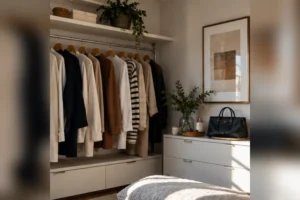
Start with your own closet.
Photograph your outfits for two weeks and look for repeated colors, shapes, shoes, fabrics, and accessories. Those patterns can reveal more about your real aesthetic than another hour of trend scrolling.
Fashion will continue changing. Your personal style can change too – just at a pace that actually belongs to you.