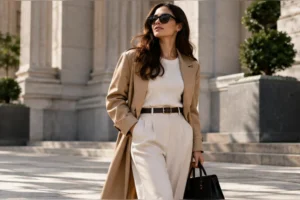

Most of us have experienced it: you put on an outfit that feels completely right, look in the mirror, and somehow stand a little taller. On another day, uncomfortable trousers or a shirt that feels “wrong” can make you unusually self-conscious.
Clothing obviously cannot create confidence from nothing. Self-esteem is shaped by many factors, including relationships, experiences, health, skills, social environment, and personal beliefs. Still, what we wear can become part of how we see and present ourselves.
Research into personal clothing style has linked clothing with self-concept, including expressions of the true self, ideal self, and creative self. In one qualitative study, participants also associated personal style with self-knowledge, consistency, and comfort.
Understanding how clothing choices influence confidence and self-perception therefore requires more than repeating “dress for success.” Fit, personal meaning, context, comfort, and identity all matter – and they do not affect everyone in exactly the same way.
1. Clothing Can Become Part of Your Self-Concept
Clothing is both practical and symbolic.
A jacket keeps you warm, but it can also communicate professionalism, creativity, rebellion, simplicity, cultural belonging, or personal taste.
Research on clothing and social identity found that observers could identify some social information from outfits people deliberately selected to represent themselves.
The researchers argued that clothing can function as one channel through which people define and communicate identity.
The same process can work inward.
When your clothing feels aligned with the person you believe yourself to be, there may be less tension between your appearance and your self-image.
Someone who values creativity might feel more comfortable wearing interesting textures or unusual accessories. Someone who identifies strongly with simplicity may feel more confident in clean silhouettes and restrained colours.
Neither approach is inherently better.
Confidence often grows when your outward presentation feels compatible with your internal identity.
2. Fit Can Change How You Evaluate an Outfit – and Yourself
A great-looking garment that constantly needs adjusting rarely feels great for long.
Fit affects physical comfort, movement, and how you perceive your apperance.
A 2024 study involving 502 fashion consumers examined clothing fit, self-evaluation, confident clothing decisions, and psychological well-being.
The results suggested relationships between fit characteristics, self-evaluation processes, body satisfaction, and confidence in clothing decisions, although the study was observational rather than proof that a particular fit directly causes higher self-esteem.
The practical lesson is useful.
Stop treating the size label as more important than actual fit.
Two people wearing the same nominal size can need very different proportions. Even two garments from the same brand may fit differently.
Choose clothing that allows you to sit, walk, reach, and move naturally.
When you are not constantly pulling a shirt down or adjusting a waistband, you have more attention available for the conversation, meeting, presentation, or activity in front of you.
3. Comfort Supports Confidence More Than Suffering for Style
Fashion sometimes encourages the idea that discomfort is the price of looking polished.
That is not a particularly sustainable strategy.
Physical discomfort constantly pulls attention back toward the body. Shoes that hurt, a restrictive jacket, or fabric that irritates your skin can make it difficult to forget about what you are wearing.
Personal-style research has identified an enduring sense of comfort as one component of how some people describe authentic clothing style.
Comfort does not mean wearing sweatpants everywhere.
Well-tailored trousers can be comfortable. Formal shoes can fit properly. Structured jackets can allow enough movement.
Look for the intersection between appearance and usability.
An outfit that looks impressive for five minutes but feels terrible for eight hours may not be supporting your confidence as effectively as something slightly simpler that lets you move naturally.
4. Context Changes How Clothing Feels
The same outfit can make you feel powerful in one environment and awkward in another.
Imagine wearing a formal suit to an important presentation. The outfit may make the situation feel more intentional and professional.
Wear that exact suit to a casual beach lunch and your experience may be completely different.
One study examining workplace attire found that respondents reported feeling more authoritative, trustworthy, and competent in formal business clothing, while casual or business-casual clothing was associated with greater perceived friendliness.
Importantly, effects also interacted with people’s own clothing preferences.
That last point matters.
There is no single “confidence outfit” that works for everybody.
The useful question is: what clothing supports the role, environment, and interaction you are entering while still feeling like you?
Contextual fit can reduce unnecessary self-consciousness.
5. Clothing May Influence Mindset – but Avoid Magical Claims
You may have heard of “enclothed cognition,” the idea that clothing can influence the wearer’s thoughts, feelings, or behavior partly through its symbolic meaning.
The concept became famous after early experiments involving lab coats.
However, the evidence is more complicated than many popular articles suggest. A large preregistered replication failed to reproduce one of the original attention effects.
A later meta-analysis examined 105 effects from 40 studies involving 3,789 participants.
The researchers raised concerns about the replicability of some earlier findings but found stronger evidential value among studies published after 2015, supporting the broader possibility that clothing can influence psychological experience under some conditions.
So wearing a blazer will not magically make you smarter.
A more reasonable interpretation is that clothing can sometimes contribute to mindset through symbolism, expectation, identity, and context.
6. Personal Style Can Reduce Appearance Anxiety
Constantly wondering whether your outfit looks “right” can make dressing exhausting.
Developing personal style can reduce some of that uncertainty.
Research on clothing style confidence defines it as confidence in the individual way someone expresses themselves through clothes and accessories. Researchers developed a multidimensional scale around the concept while exploring its possible relationship with longer clothing use.
Personal style provides a framework.
You begin learning which trousers work, which colours feel natural, which proportions you repeatedly prefer, and which acessories make simple outfits feel complete.
This knowledge makes dressing more predictable.
You no longer need every outfit to follow the latest fashion recommendation because you already understand your own visual preferences.
That can make confidence more consistant because it depends less on external approval.
7. Use Clothing to Support the Person You Want to Be
Clothing can also act as a small behavioral cue.
Perhaps you have a specific outfit for focused work, gym clothes prepared before exercising, or clothing you reserve for important professional situations.
These transitions can help signal that you are entering a different activity or role.
This does not mean pretending to be someone else.
Think of it as supporting an existing intention.
If you want to feel prepared before a presentation, choosing clothing the night before can reduce morning stress. If changing out of work clothes helps you mentally finish the workday, that can become part of your routine.
Clothing works best when it supports behavior rather than attempting to replace skill or preparation.
A great suit cannot prepare your presentation.
It may, however, help you enter the room feeling organized and ready to deliver what you already know.
8. Avoid Building Confidence Entirely Around Appearance
There is an important limit to all of this.
Clothing can support self-expression, but confidence becomes fragile when appearance is its only foundation.
Your worth should not depend on wearing the perfect outfit, having a fashionable body shape, owning expensive brands, or receiving compliments.
Fashion standards also change constantly.
If confidence depends entirely on meeting them, the target never stops moving.
Use clothes as one tool for self-expression rather than a daily test of whether you look acceptable.
Choose pieces that support your body rather than treating your body as something that must earn the clothing.
Creating that enviroment in your wardrobe can make getting dressed feel more enjoyable and less judgmental.
9. Build Confidence Through Clothing Experimentation
Understanding your style takes experimentation.
Try different silhouettes, colours, levels of formality, fabrics, and combinations. Pay attention to how you actually feel after wearing them for several hours – not just during the first mirror check.
Take outfit photos if useful.
After several weeks, patterns become visible.
Maybe you repeatedly feel confident in structured outerwear. Perhaps monochrome outfits make dressing easier. You might discover that bright colours genuinely energize you—or that you feel far more comfortable in muted shades.
Do not search for a universal formula.
Build your own evidence.
The best wardrobe is not necessarily the one other people admire most. It is the one that helps you participate in your life without constantly worrying about what you are wearing.
Clothing choices can influence confidence and self-perception, but the relationship is more nuanced than simply “dressing well makes you confident.”
Fit, comfort, identity, personal preference, symbolism, and social context can all shape how an outfit feels.
Research also suggests that clothing can sometimes influence self-perceptions and psychological experience, although effects vary and should not be exaggerated.
Start by paying attention to your own wardrobe.
Notice which outfits let you move naturally, feel recognizable, and focus less on your appearance once you leave the mirror.
Keep those patterns and build around them.
Clothing does not need to create a new personality. At its best, it can help you express the person who is already there with greater comfort and confidence.