
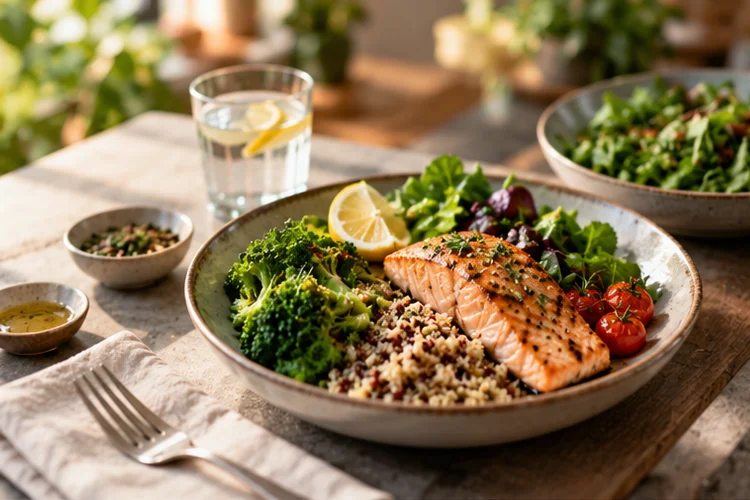
Have you ever eaten a large meal and somehow felt hungry again two hours later? Or finished lunch feeling so heavy that getting through the afternoon suddenly became a challenge?
What you eat matters, but the way a meal is structured matters too.
How meal structure influences energy and daily satisfaction comes down to several connected factors: protein, carbohydrates, fiber, fats, food quality, portion size, timing, and how satisfying the meal feels in real life. No single formula works perfectly for everyone.
The World Health Organization describes a healthy diet around four broad principles: adequacy, balance, moderation, and diversity. It also emphasizes minimally processed foods, whole grains, vegetables, fruits, pulses, and suitable protein sources as foundations of healthy eating.
The practical goal is not to engineer every plate with mathematical precision. It is to create meals that give your body useful fuel, keep hunger manageable, and make everyday eating enjoyable enough to maintain.
1. Think of a Meal as a System, Not a Single Nutrient
People often build meals around one question: “Where is the protein?” or “How many calories does this have?”
Those questions can be useful, but a complete meal works as a system.
Protein contributes amino acids, carbohydrates provide an important source of energy, fats have essential physiological roles, and fiber-rich foods add nutrients and affect digestion.
WHO recommends dietary balance across these major sources rather than treating one macronutrient as universally superior.
A practical lunch might combine rice or another grain, vegetables, fish, chicken, tofu, eggs, or beans, plus a source of healthy fat.
That structure usually offers more nutriton than building lunch entirely around one highly refined food and hoping coffee carries you through the afternoon.
Variety matters as well. A meal pattern that includes different vegetables, fruits, grains, legumes, and protein sources can make it easier to obtain a wider range of nutrients.
2. Include Protein to Make Meals More Substantial
Protein deserves a place in meal planning, but it does not need to dominate the plate.
WHO notes that proteins provide building materials for structures such as muscle as well as functional molecules including enzymes and hormones. Protein can come from both animal and plant sources.
Protein can also influence how filling a meal feels. Research has long examined protein’s relatively strong satiating properties, although the effect varies with the meal, amount, food form, and individual.
Instead of eating very little protein all day and trying to compensate with one enormous dinner, consider including a suitable source in your regular meals.
Breakfast might contain eggs, yogurt, tofu, or beans. Lunch could include fish, poultry, lentils, tempeh, or another protein source.
The exact amount depends on body size, activity, age, health status, and overall diet, so there is no need to force every meal toward the same target.
3. Pair Carbohydrates With Fiber-Rich Foods
Carbohydrates are often blamed for afternoon tiredness, but the category is far too broad for that conclusion.
Fruit, lentils, oats, brown rice, pastries, sugary drinks, and white bread all contain carbohydrates, yet their nutritional profiles are very different.
WHO recommends that carbohydrate intake come primarily from foods such as whole grains, vegetables, fruits, and pulses. For people older than 10, it recommends at least 25 grams of naturally occurring dietary fiber per day.
CDC guidance similarly notes that fiber supports digestive health and can help people feel fuller for longer. Good sources include vegetables, fruits, whole grains, legumes, nuts, and seeds.
Harvard’s Healthy Eating Plate also emphasizes carbohydrate quality, recommending whole or minimally processed grains over refined alternatives.
So instead of simply removing carbohydrates, improve the company they keep.
Rice with vegetables and beans creates a very different meal structure from a sugary drink and pastry eaten on the run.
4. Do Not Treat Breakfast as a Universal Rule
Breakfast is a perfect example of why nutrition advice needs context.
Some people feel considerably better after eating in the morning. Others naturally prefer their first substantial meal later.
Research does not support the simplistic claim that everyone must eat breakfast for good health or weight management.
A review of clinical trials found positive-to-neutral evidence for breakfast in appetite control and satiety, with meal composition – particularly protein, energy content, and whether food was solid or liquid – affecting the response.
In other words, what breakfast contains may matter as much as simply checking the “ate breakfast” box.
A sweet drink and pastry may create a very different experience from oats with yogurt, nuts, and fruit.
Rather than following a rigid rule, notice what structure supports your concentration, hunger, training, work schedule, and overall eating pattern.
5. Meal Timing Matters, but There Is No Perfect Clock
Researchers are increasingly interested in chrononutrition: how food timing interacts with the body’s circadian rhythms.
Reviews suggest that eating patterns and metabolic processes are connected to circadian timing, and very late or irregular eating may create different metabolic conditions than eating during the biological daytime.
That does not mean everyone needs breakfast at 7:03 a.m. and dinner at 6:14 p.m.
Work schedules, chronotype, family routines, exercise, culture, and medical needs all influence realistic meal timing.
A more practical strategy is establishing a reasonably consistant pattern that prevents you from repeatedly reaching extreme hunger.
For example, if skipping lunch leads to uncontrolled snacking at 5 p.m., the issue may not be a lack of discipline. Your meal schedule may simply be poorly designed for your day.
Structure should reduce problems, not create new ones.
6. Build Plates That Feel Satisfying, Not Merely “Healthy”
Nutrition quality matters, but satisfaction matters too.
A meal that looks perfect on paper but leaves you craving something else fifteen minutes later is not necessarily a useful everyday system.
Harvard’s Healthy Eating Plate offers a simple visual framework: roughly half the plate from vegetables and fruits, with the remaining space divided between whole grains and healthy protein, alongside healthy oils and water.
It is presented as a flexible guide rather than a prescription for exact calories or serving sizes.
You can adapt that principle to different cuisines.
A curry, grain bowl, soup, sandwich, pasta dish, or traditional family meal does not need to physically resemble a segmented plate.
Think instead about balance.
Does the meal include something substantial for protein? Is there a meaningful source of fiber? Are the carbohydrates mostly coming from useful food sources? Does it contain enough flavor and texture to create satisfation?
Healthy meals should still taste good.
7. Use Snacks to Solve a Problem, Not Because the Clock Says So
Snacks are neither automatically healthy nor unhealthy.
Their usefulness depends on what your meals look like and what your day requires.
If lunch happens at noon and dinner cannot happen until 8 p.m., a planned afternoon snack may prevent extreme hunger. Someone with a shorter gap between meals may not need one.
Structure snacks the same way you structure meals.
Fruit with yogurt, nuts with fruit, vegetables with hummus, or another combination of fiber and protein may feel more substantial than grabbing something simply because it is convenient.
Also consider the food enviroment around you.
If the only snacks available at work are foods you do not really want, bringing something from home removes an unnecessary decision when hunger arrives.
The purpose is not constant eating. It is making your overall pattern fit your actual day.
8. Pay Attention to Energy Patterns After Meals
Your body gives you useful feedback.
For a week, notice what happens after your regular breakfasts and lunches.
When does hunger return? Do you feel comfortably satisfied or excessively full? Can you focus? Does a particular lunch make afternoon work harder simply because the portion is much larger than you needed?
Do not jump to conclusions after one meal.
Sleep deprivation, stress, caffeine, hydration, exercise, illness, and many other factors can influence perceived energy.
Instead, look for repeated patterns.
If the same breakfast leaves you hungry every morning, modify its structure. Add a source of protein, fiber, or more total food.
If lunch regularly feels too heavy, experiment with portions or composition.
Intentional meal planning is not about copying somebody else’s perfect menu. It is about testing a reasonable structure and learning how it works for you.
9. Personalize the Structure to Your Health and Lifestyle
A general healthy-eating template cannot account for everyone.
Athletes may have different energy and carbohydrate requirements than sedentary adults. Older people may need to pay particular attention to maintaining adequate protein and overall food intake.
People managing diabetes, kidney disease, gastrointestinal disorders, food allergies, pregnancy, eating disorders, or other health conditions may require more individualized guidance.
WHO itself emphasizes that the exact composition of a healthy diet varies with characteristics including age, lifestyle, activity level, cultural context, available foods, and dietary customs.
Use general meal structures as tools rather than strict rules.
If your medical situation affects what, when, or how much you should eat, individualized advice from an appropriate healthcare professional or registered dietitian can be more useful than generic online meal plans.
Meal structure can influence how satisfying everyday eating feels and how easily you maintain steady eating habits throughout a busy day.
Instead of searching for one perfect meal schedule, focus on the fundamentals: include useful protein sources, choose fiber-rich carbohydrates, add vegetables and fruits, pay attention to portions, and create meal timing that fits your routine.
Then observe how the pattern actually works.
Start with one meal you eat frequently. Adjust its structure rather than completely replacing it – perhaps add protein to breakfast, vegetables to lunch, or a planned afternoon snack.
Good eating habits do not require perfect menus. They require a practical structure you can repeat, enjoy, and adapt as your lifestyle changes.