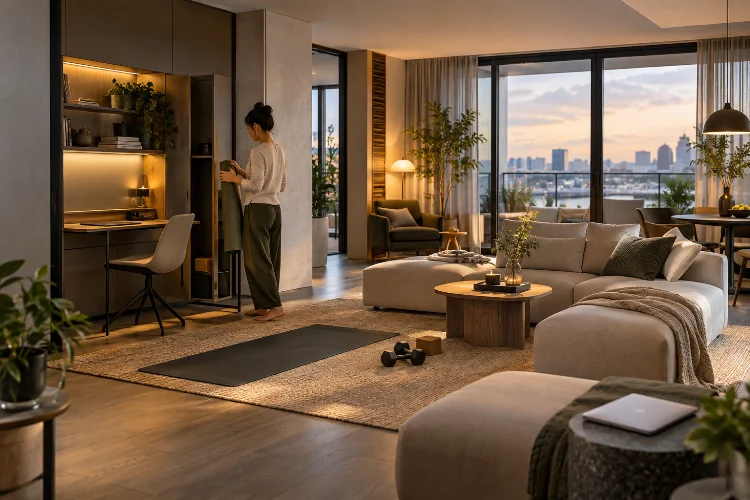
The modern home has become much more than a place to eat, sleep, and relax. For many people, it is now an office, classroom, workout space, entertainment zone, creative studio, and social hub – sometimes all within the same day.
That shift creates a design challenge. A room that works perfectly for a quiet Sunday morning may feel completely wrong during a video meeting on Monday afternoon.
This is why designing flexible living spaces for modern hybrid lifestyles has become increasingly important.
Recent residential design trends reflect growing interest in adaptable spaces that can support changing household needs rather than remaining locked into one function.
The American Institute of Architects reported in September 2026 that homeowner interest continues to center on maximizing space while maintaining flexibility.
Flexible design does not mean filling your home with complicated moving walls. It means creating rooms that can change purpose easily, stay comfortable, and support work and personal life without one constantly taking over the other.
1. Start With Activities Instead of Traditional Room Labels
One of the easiest ways to make a home more adaptable is to stop thinking only in terms of “bedroom,” “living room,” or “dining room.”
Instead, think about activities.
Where do you work? Where do you exercise? Where do children study? Where do guests stay? Where do you need privacy for calls?
Research on housing flexibility has long emphasized that homes need to respond to changing activities, household structures, and user requirements rather than remaining physically fixed.
A rarely used dining room, for example, could become a weekday workspace while still functioning as a dining area in the evening. A guest bedroom might include a foldaway desk so it works as a quiet office when nobody is visiting.
The goal is not to make every room do everything.
It is to identify spaces that can realistically support two or three compatible activities.
2. Create Zones Without Permanently Dividing the Room
Open-plan homes offer flexibility, but they can also create confusion when every activity happens in the same visual field.
Zoning solves this problem.
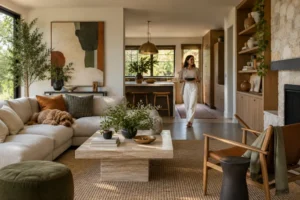
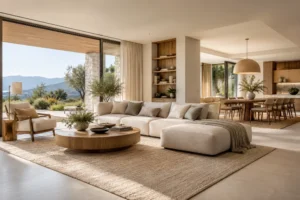
A rug can define a lounge area. A bookcase can create partial seperation between a workspace and living zone. Different lighting can signal that one corner is for working while another is designed for relaxation.
Use Boundaries That Can Change
Flexible homes benefit from boundaries that are easy to modify.
Curtains, lightweight screens, shelving units, sliding panels, and movable furniture can create temporary privacy without permanently shrinking the room.
During the workday, a screen might hide a desk from the sofa. In the evening, it can be moved aside to restore the sense of a larger living area.
This approach is especially useful in apartments where one room may need to support several people and activities.
Flexibility works best when occupants remain in control of how spaces are organized. Research into adaptable housing similarly highlights the importance of allowing users to manage and reorganize their living environments.
3. Choose Furniture That Does More Than One Job
Furniture can either increase flexibility or quietly destroy it.
A huge sectional sofa may be comfortable, but if it dominates the room, it becomes difficult to change the layout later. Large fixed desks, oversized dining tables, and heavy storage units can create similar problems.
Choose pieces that support movement and multiple uses.
An extendable table can work as a dining table, project surface, or temporary workstation. Nesting tables can disappear when extra floor space is needed. An ottoman with storage can provide seating, hide household items, and function as a small table.
Movable furniture is particularly useful because a hybrid lifestyle rarely follows exactly the same schedule every day.
The room may need to feel like an office at 10 a.m., a workout area at 5 p.m., and a social space at 8 p.m.
A funcional flexible interior makes those transitions simple rather than exhausting.
4. Design a Workspace That Can Disappear
Working from home created one of the biggest pressures on residential space.
A laptop on the dining table may work occasionally, but it becomes less practical when remote work is a regular part of the week.
NIOSH recommends creating a work-ready environment where lighting, noise, temperature, and ergonomics can be controlled. It also suggests maintaining boundaries between work and personal life when working remotely.
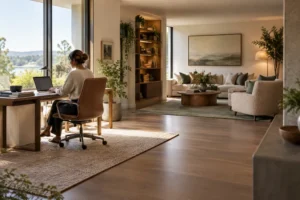
If a dedicated office is impossible, create a dedicated work zone.
A compact desk inside cabinetry can be closed after work. A console table can double as a workstation. A small desk can occupy an unused corner rather than dominating the bedroom.
Ergonomics still matter.
OSHA notes that workstation design should consider posture, equipment placement, and individual requirements rather than relying on a single “correct” setup for everyone.
Most importantly, give work a visible ending.
Closing a laptop, putting equipment into storage, or physically concealing the workspace can help the room return to personal use.
5. Build Storage Around Transitions
Flexible spaces need excellent storage.
Without it, every change of activity creates a new pile of equipment.
Imagine converting a living room into a workout space. If exercise equipment requires fifteen minutes of moving furniture and searching through cupboards, the room is technically flexible but practically inconvenient.
Store objects close to where they are used.
Place workout equipment in a nearby cabinet, work accessories beside the desk, toys near the children’s activity area, and chargers inside accessible drawers.
Closed storage can be particularly useful in hybrid spaces because it allows a room to visually reset.
A workspace should not necessarily look like an office during dinner. Exercise equipment does not need to remain visible while guests are visiting.
Good storage makes transformation quick enough that people will actually use it.
6. Use Lighting to Change the Mood and Function
Lighting is one of the easiest ways to make one space feel like several different rooms.
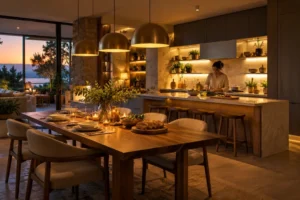
A bright task lamp can create a focused workspace during the day. In the evening, warmer ambient lighting can make the same area feel relaxing.
Instead of depending on one ceiling fixture, create layers.
Combine general lighting with floor lamps, desk lamps, pendant lights, and daylight where available. Separate controls are particularly useful because different zones may be used simultaneously.
Furniture placement should also respond to natural light.
For home working, NIOSH recommends managing glare and positioning screens carefully in relation to windows.
A flexible lighting enviroment allows the room to change psychologically even when the furniture stays in exactly the same place.
7. Manage Noise and Privacy for Hybrid Activities
Hybrid living creates more sound conflicts.
One person may be attending a video meeting while someone else watches television, cooks, studies, or plays nearby.
Flexible design therefore needs acoustic thinking.
Soft furnishings such as rugs, curtains, upholstered seating, fabric panels, and bookshelves can help reduce sound reflection. Doors, partitions, and screens can provide additional separation where privacy is needed.
Headphones can help too, but they should not become the only acoustic strategy.
Think about which activities naturally belong together.
Quiet study and remote work can share a zone more successfully than remote work and television. Exercise might work near an outdoor area, while reading may benefit from the quietest corner of the home.
The goal is to reduce conflicts before they happen.
8. Keep Airflow and Comfort Flexible Too
Space planning should not block environmental comfort.
The U.S. Environmental Protection Agency notes that ventilation is one of the key strategies for reducing indoor pollutant concentrations, alongside controlling pollution sources and using appropriate filtration.
This matters when rooms change function.
A storage room converted into a regular workspace may require different ventilation, lighting, and temperature considerations because it is now occupied for several hours each day.
Do not place large furniture directly over vents or completely block windows needed for ventilation.
A flexible interior should adapt not only visually but also in terms of comfort.
Air quality, temperature, glare, noise, and ergonomics all affect whether a multifunctional room actually feels pleasant to use.
9. Design for Future Changes, Not Just Today’s Routine
The strongest argument for flexible design is that lifestyles do not remain static.
Remote workers may eventually return to offices several days a week. Children grow up. Parents may move in. Hobbies change. Mobility requirements can change with age.
Research into building adaptability argues that designing for future modification can reduce the need for premature demolition or major reconstruction when requirements change.
This does not mean predicting every future scenario.
Instead, avoid unnecessary rigidity.
Choose furniture that can move, storage that can be reorganized, rooms with useful proportions, and layouts that do not depend entirely on one specific activity.
A consistant principle of flexible design is simple: make today’s home work well without preventing tomorrow’s home from working differently.
Designing flexible living spaces is really about giving your home permission to change with you. Modern hybrid lifestyles require spaces that can support work, relaxation, exercise, family activities, entertainment, and social life without becoming chaotic.
Start by studying what actually happens in your home. Create clear zones, choose adaptable furniture, build storage around activities, manage lighting and noise, protect indoor comfort, and make workspaces easy to close at the end of the day.
You do not need moving walls or futuristic technology.
Begin with one room that currently struggles to serve multiple purposes. Remove unnecessary obstacles and redesign it around smoother transitions. A genuinely flexible home is not one that does everything at once – it is one that changes easily when life does.